
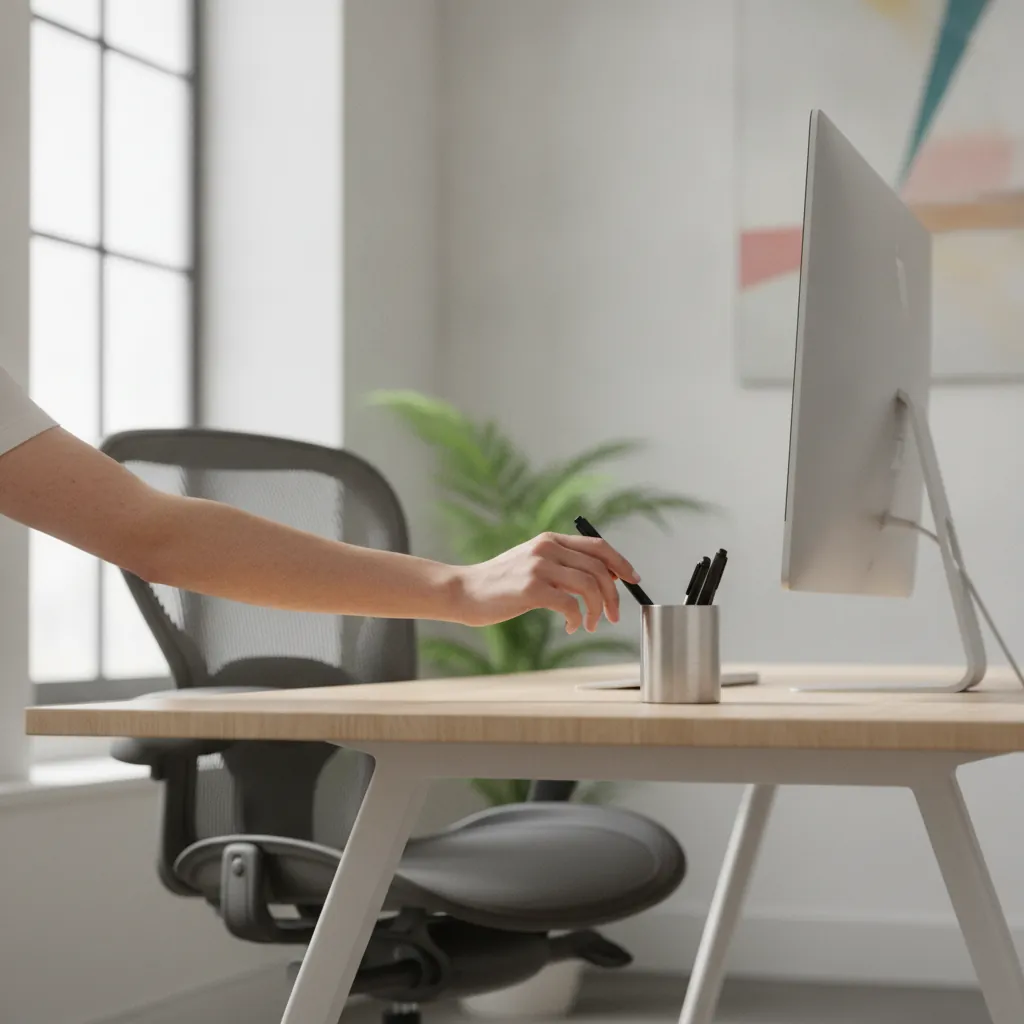
Decorate an office through the things people use all day: the seating, the work surfaces, the panel fabric, the lighting and the storage. Keep monitors out of direct window glare, keep walkways and exits clear, and keep the surfaces people actually work on free. Art, plants and personal touches land last, on top of a workspace that already works.
An office is a shared room with daylight, noise, sightlines and a fire exit running through it. Which is why most of what makes one look better turns out to be a furniture decision, not an accessory you add later.
Where to Start: The Furniture People Touch All Day
The fastest visual change in an office comes from the pieces already sitting in it. They take up the most square footage, so they set the palette whether you meant them to or not.
Look at these five, in this order:
- Seating. Chairs are what your team sits in all day and what a visitor forms an opinion about within seconds of sitting down. A current office seating line gives you a seat shell, a back and a fabric choice, so a chair can carry your color without a single accessory being added.
- Work surfaces. Laminate finish and edge profile date an office faster than paint does. Swapping tops is often cheaper than replacing whole desks.
- Panel fabric. On a cubicle floor, the panels are the largest colored surface in the building. New fabric on existing cubicle panels and workstations changes the whole room while the layout stays exactly where your data and power already run.
- Lighting. More on this below. It's usually the change that does the most for a room.
- Storage. Every visible pile is a storage gap. Closed storage counts as decor, because it clears the clutter you were about to decorate around.
Spend here and the money stays in things that still have to be in the building in five years.

The Four Things Decor Usually Breaks: Glare, Noise, Sightlines and Surfaces
These four account for most of the damage, and each one is easy to avoid if you catch it before the order goes in.
Glare. A monitor facing a window, or sitting under a new glossy accent wall, picks up reflections all day. People deal with it by tilting screens, closing blinds and squinting at them. Set screens perpendicular to the windows where you can, and keep the finishes near desks matte.
Noise. Hard, shiny surfaces reflect sound. Pulling up carpet, adding glass and taking out panels all make a room brighter and louder at the same time. Soft goods, fabric panels and upholstered lounge pieces buy back the quiet.
Sightlines. A tall plant, a new shelf or a stack of art can quietly block daylight, a walkway, or the line of sight a team uses to talk to each other. Stand where your people sit before you commit to anything tall.
Work surfaces. The desk is where the work happens, and decor that lives on it competes for the same square footage. Move it up onto walls and shelves, or into closed storage, and the surface stays usable.
Color and Branding in an Office: Where to Put It
Saturated color reads best where the eye rests occasionally rather than where it focuses for hours. Reception, lounge, a feature wall, a run of panel fabric, a set of seat shells: those places carry brand color well.
Around monitors, keep it calmer and keep it matte. The wall directly behind a screen is the one spot in the office where a bold color works against the person sitting there.
Brand color in reception and lounge furniture does double duty, because reception is the part of your office a client actually sees.
Plants, Art and Lighting in a Commercial Office
Lighting is usually the biggest gap. Most offices run one flat layer of overhead light and stop there. Add a second, closer layer, task lamps at the desks and warmer lamps in the lounge, and the whole room changes. It also hands people some control over their own light, which tends to be the part they thank you for.
Plants work when they're somewhere they can survive and out of the walking path. Low-maintenance plants in a shared office get watered. Demanding ones turn brown and remind everyone that nobody is in charge of them.
Art belongs at seated eye level in a room where people are seated. Hung at standing height, it floats above everyone all day.
What You Cannot Decorate Around: Exits, Sprinklers and Your Lease
A few of these are code and lease questions rather than style questions, and they're cheaper to check now than to undo later.
Exits, exit signage and the path to them generally have to stay clear and visible. Sprinkler heads typically need clearance around and below them, which rules out hanging things off them or stacking storage right up to the ceiling. Walkways need to stay wide enough to walk, including for anyone using a mobility device.
If you lease, the lease usually decides what you can paint, drill, mount or remove. Specifics vary by building and by local code, so confirm yours with your landlord and your local fire code before the work gets scheduled.
Cubicle and Desk Decorating: What to Let Employees Do
Personal space is where employees want a say, and it's the cheapest goodwill in the building. A short, plain policy covers most of it: nothing on the sprinkler or the lights, nothing blocking a walkway or an exit, nothing on the outward-facing panel that the whole floor has to look at, and nothing adhesive that wrecks the panel fabric.
Inside those lines, let people make their own space theirs. If your team wants specifics, we've written separately about decorating a cubicle and about decorating an office desk. Either one is a fine thing to hand out.
Do You Need an Interior Designer, and What Does It Cost?
For a repaint and some art, no. Once you're changing furniture, moving people or reworking a floor plate, a designer earns the fee, because the expensive mistakes in an office are dimensional ones. Aisles that come up too tight. A conference table that doesn't clear the chairs behind it. Panels that land on top of a power pole. Those get discovered on installation day, when they cost the most to fix.
Cost depends on the size of the space, how much you keep, and the lines you choose, so it comes back as a quote rather than a price list. Reusing what you already own is usually the biggest single saving on that number.
Rochester Office Interiors in Rochester, NY
Rochester Office Interiors is a family owned office furniture dealer in Rochester, NY, with more than 30 years in the business. Andy Draveck and the team come at this from the install side. Andy started his career in 1991 as an installer, which is a useful place to have started, because installation day is when the drawing finally meets the actual room.
The work covers the whole job: planning, specification and installation, with an in-house interior design team, plus modifications to setups you already have when the right answer is to keep most of what's in the building.
"They helped us immensely with finding quality furniture & cubicles that fit our budget and needs."
Joseph Pecoraro
"Andy and his subs are professional, knowledgeable, and efficient."
John and Nicole Moore
If you're planning an office refresh in the Rochester area, ask for a quote or call (585) 749-2428. We'll work through the layout, the budget and the finishes with you before anything gets ordered.
FAQ
Can you decorate an office on a small budget?
Yes, and the cheapest changes are often the ones that show most: task lighting, closed storage that clears the surfaces, new panel fabric, and paint in the areas the eye rests on. Furniture you already own can often be refinished or recovered instead of replaced.
What color should an office be?
Keep it calm where people focus, and save the saturated brand color for reception, lounge and feature areas. Matte finishes near screens will do more for the room than the specific hue you pick.
Do plants actually help an office?
They make a room feel better and they soften hard surfaces. Choose low-maintenance ones, give someone responsibility for watering them, and keep them out of walkways and off the sightlines people need.
Can you decorate an office you rent?
Usually, within limits your lease sets on painting, drilling and mounting. Freestanding furniture, lighting, plants and art are the moves that rarely require permission. Check the lease before anything gets attached to the building.